A conference social wall for three days and six tracks.
A conference social media wall has to work across several days and parallel rooms, stay interesting on day three, and give sponsors something to point at. That makes it a planning job: screens, sources and a rota.
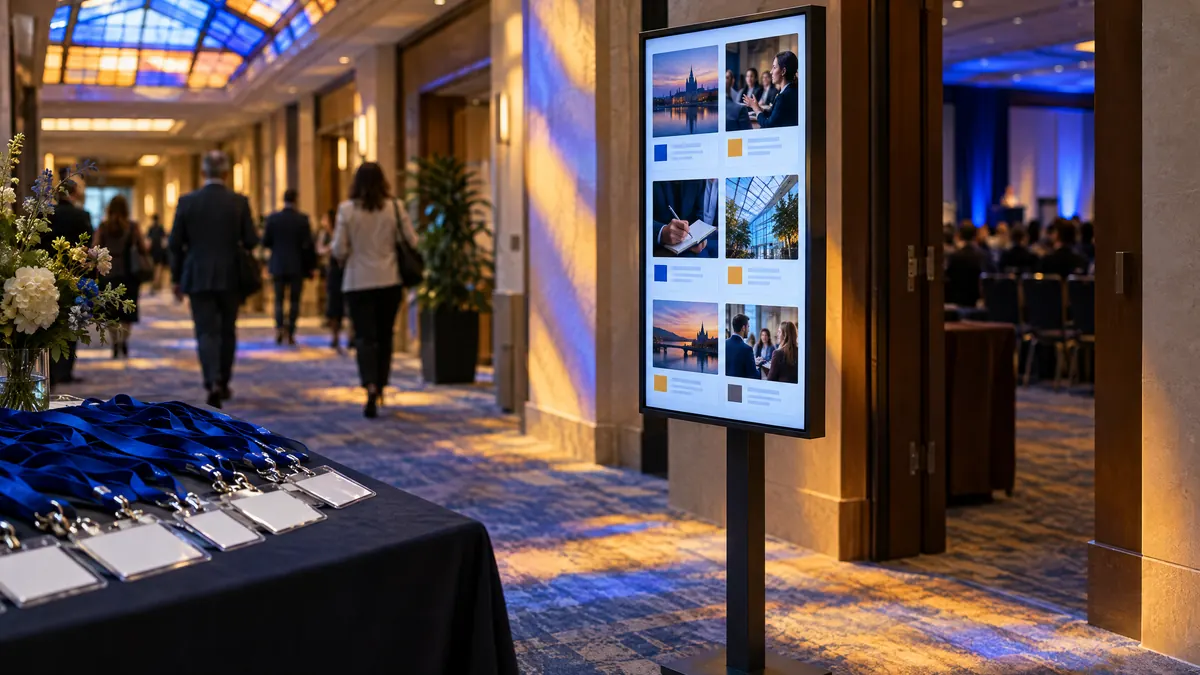
What a conference changes about a social wall.
Time and parallel rooms. A one-evening wall can be fed by one tag and watched by one person. A conference social media wall runs for days, needs a wall for each room, needs a rota of moderators, and needs fresh material on day three, when posting falls away.
Rooms
A wall per room, not one wall for everything.
Six tracks on one wall is noise. A wall outside each room, showing that room’s session, is the version delegates actually stop and read.
| Screen | Shows | Collected from | Layout |
|---|---|---|---|
| Main stage foyer | Everything approved, with speaker moments pinned | Your accounts and the event tag | Social wall, dark |
| Outside each track room | That track only | The track's own tag | Full width, a few large tiles |
| A sponsor's stand | Posts about the sponsor | The sponsor's tag or mentions | Grid, in their colours |
| Registration | Highlights while people queue | Your own accounts, pinned posts | Full width, slow |
Tell rooms apart by source. Approving a post approves it on every wall it appears on, so the difference between rooms has to come from what each one collects. Give every track a short tag of its own and print it on that room’s screen and slides.
Count the feeds. A six-track event with the screens above needs 9 feeds, one per screen. That fits Growth (10 feeds) or Scale (25 feeds); the pricing page has the rest of each plan.
Three days
Day one is easy. Day three is the job.
Day one
Everyone posts in the first two hours.
- Keep two people on the queue through the morning peak.
- Pin the opening keynote's best moments early; they carry the quiet afternoon.
Day two
Steady, and mostly about sessions.
- Re-seed each room's wall with that room's speakers before doors.
- Swap yesterday's pins for today's; a wall still showing day one looks abandoned.
Day three
People are tired and posting less.
- Post your own recap of days one and two first thing, so the walls have material.
- Lean on pinned posts between sessions; that is most of what pinning is for.
Moderation
A rota, not a volunteer.
The risk at a conference is not one bad post. It is the twelfth hour, when whoever is watching the queue is tired. Put the queue in the run sheet like any other job. How approval works is covered on the event social wall page.
At every handover
- Say out loud who now has the queue.
- Clear what is waiting, so the next person starts at zero.
- Pass on anything contentious that is being watched.
| Shift | Day one | Day two | Day three |
|---|---|---|---|
| 08:00 to 12:00 | Comms lead + Volunteer A | Volunteer A | Volunteer B |
| 12:00 to 16:00 | Volunteer B | Comms lead | Volunteer A |
| 16:00 to close | Volunteer A | Volunteer B | Comms lead |
Two people on the first morning, because that is when most posts arrive. Nobody holds the queue for two shifts in a row.
A screen on the stand, and a link afterwards.
Sponsors ask what they got. A wall on their stand that collects their tag or mentions answers it during the event, and the same feed, kept published, answers it afterwards: send the link instead of a slide of screenshots.
After the close, keep the main wall live on the event site. Filter it to speaker moments for the call for papers, and to attendee posts for next year’s ticket page. Nothing needs collecting again; it is the same feeds in different places.
Planning something else?
Social walls for events
The plan from four weeks out to the week after, and how to moderate on the day.
Read the guide
Live social walls
Every step between a post and the screen, with the real numbers.
Read the guide
Social walls for digital signage
Sizing for the room, and setting up a display machine that runs for months.
Read the guide
Conference walls, answered.
Yes: one feed per room, each with its own source. Approving a post approves it everywhere it appears, so rooms are told apart by what they collect rather than by what you approve. Give each track its own short tag and use it as that room's source.
Decide the rule before the event, not during it. Most conferences approve substantive disagreement and hide personal attacks. What matters is that whoever is on shift knows the rule rather than having to invent it at 4pm.
Yes. A feed that collects the sponsor's tag or mentions, shown on a screen at their stand, is a simple package to sell. It costs you a feed and a source, and the posts themselves are the report you send afterwards.
Pinned posts. They keep the strongest material on screen through the quiet stretches, which at a conference is most of the afternoon.
Give every room a wall of its own.
Start on the free plan with one wall, and add a feed per room when the programme is set.
Start free